Sunday, February 25, 2024

The History of the Commonwealth Bank in Weston, New South Wales

© Feb 2024, Peter J Williams, Grad Dip Local and Applied History

Before 1946

At the time of the federation of the Australian colonies in 1901, provision was made in the new Constitution (Section 51) for the Commonwealth Government to legislate regarding “banking other than State banking”. It was thought that a Commonwealth Government Bank was needed to implement federal works, such as the completion of a federal capital, development of the defence services and similar projects.1

The following year, the Australian Agricultural Company commenced mining operations on land adjoining the late James Weston’s grant. In 1903, Weston’s heirs subdivided their property to create the private township of Weston. The mine and town were rapidly developed over the following years. Calls for the establishment of a branch of the Government Savings Bank in Weston were made in June 1904.

“Weston.
Savings Bank.
The following letter has been received by Mr J Gillies, MP, from the Treasury:-‘Referring to the letter of the 27th April, addressed to you by the Weston Progress Committee, and by you presented at the General Post-office, urging the establishment of a branch of the Government Savings Bank at Weston, I have the honour, by direction of the Premier and Colonial Treasurer, to inform you that a branch will be opened at that place on the 1st July.”2

It is unclear if those early plans were enacted, as three years later, calls were still being made for a bank in Weston.

“Weston.
The Weston Progress Committee met at the Aberdare Hotel on Friday last, Mr R B Emanuel presiding…
Lengthy discussion took place re approaching some banking company to open a branch at Weston, and it was resolved to ask the co-operation of various progress committees of the district, and also business people, to give their support in establishing a bank at Weston, it being the most suitable and central town.”3

Eventually, a branch of the State Savings Bank was established in Weston, perhaps in the period 1910 to 1914.4

As a preliminary step towards creating a commonwealth bank, in 1910, the Commonwealth Government assumed sole control over the issue of bank notes in Australia.5

Clark described the period 1901 to 1919 as “The Age of the Optimists”. He wrote that the Labor Party’s “contribution to social welfare legislation between 1910 and 1913 was meagre. They passed an act to create the Commonwealth Bank that, after the froth and bubble talk of a people’s bank had been skimmed off, was the old pale brew. The existing system of banking was to be made more efficient by introducing competition between private and state enterprise.”6

The Commonwealth Bank Act of 1911, introduced by Andrew Fisher’s Labor government, established the Commonwealth Bank of Australia, taking effect on 22 December that year. Provision was made for both savings and general bank business, and a federal government guarantee. The first branch was opened in July 1912 in Melbourne. Bank business was also transacted through post office agencies. By 1913, there were branches in all six states. The head office was moved to Sydney in 1916.7

Ward wrote:

“Easily the most controversial legislation was the creation of the Commonwealth Bank, sponsored most vociferously, if not always most effectively, by King O’Malley, a colourful Tasmanian Labor representative in the federal Parliament from 1901 to 1917… the Commonwealth Bank was to be a ‘people’s bank’ which would drive ‘capitalist banks’ out of existence and usher in the millennium, and it was to help and comfort private enterprise too. In fact, from its inception the Commonwealth Bank controlled the note issue and increasingly exercised central banking functions. At the same time, it competed successfully with private banks for all ordinary business and soon became the dominant financial institution of the country.”8

During WWI, the banks played a very important role in financing wartime operations. In 1929, the Commonwealth Bank took over the gold reserves, and in following years during the Depression helped to establish the basis for recovery.9 During WWII, in emergency war-time legislation, the Bank received almost all central bank powers. In the years after the war, the Bank expanded, opening hundreds of branches throughout Australia.10

The First Building 1946 – The Agency (Rented Premises)

On 21 January 1946, an Agency of the Commonwealth Bank of Australia was established at Weston. The Agency was attached to its parent branch at Kurri Kurri and was available for the transaction of general business banking only. It operated from 74 Cessnock Road, Weston, in premises leased from Nathan Mark Bailey for twelve months, with an option to renew for a further 12 months. The opening hours of the Agency were Monday and Friday, from 10 am to 1 pm only.11

Nathan Mark Bailey12 was born in 1886 at St Albans, Macdonald River, son of Mark Bailey and Ann Harris. He was married in 1909 in Sydney to Ida Maud Phelps. Nathan was a blacksmith and contractor by occupation. They had four children in the Marrickville district prior to 1918. The family had interests in Weston prior to 1914 and later lived at 53 Second Street. Around 1956, they retired to 29 West St, Petersham, Sydney, where Mrs Bailey died in 1957, and Nathan in 1966. Nathan’s brother, William Harris Bailey, was a butcher in Weston by 1947, operating from premises on Cessnock Road.

The allotment at 74 Cessnock Road, Weston, is in the Parish of Stanford, County of Northumberland and was originally part of the large section in that parish, numbered 68, granted to John Terry Hughes in 1839. That section was later acquired by the Australian Agricultural Company (as part of its coal mining interests). The Company subdivided several allotments from section 68 and made them available for sale. This allotment was designated as Lot 5 in Section C of the subdivision, and was sold on 5 May 1909 to John Blackwell of Weston, miner. Blackwell sold the allotment on 4 August 1913 to Alexander George Jewell of Weston, proprietor of the Aberdare Hotel. Jewell in turn sold the property on 30 April 1914 to Nathan Mark Bailey of St Albans, blacksmith. Bailey mortgaged the property on 11 September 1924 with the Australian Bank of Commerce Limited. On 19 July 1926, he leased part of the property (with the consent of the mortgagee) to William Noel Paul of Weston, chemist. The lease expired on 28 February 1934. Bailey took a second mortgage on that date, this time with the Bank of New South Wales. The first mortgage, with the Australian Bank of Commerce Limited, was discharged on 6 March 1934, and the second mortgage was discharged on 4 November 1946. The Certificate of Title has no mention of the lease to the Commonwealth Bank of Australia in January 1946 – there was probably no legal reason to endorse the Certificate of Title for that purpose. The property was sold on 16 October 1961 to Ronald Bailey of Kurri Kurri, butcher. There were several later leases - to Dallis Goodall of Stanford Merthyr, hairdresser; Dallas Taggart; Arthur Alan Roach and Carol Ann Roach; and Maria Louise Harvey - after which, the title converted to a computerised folio after 1988.13

The opening of the new bank agency at Weston in 1946 was announced in the press.

“Bank Agency at Weston.
Commencing next Monday, Kurri Kurri branch of the Commonwealth Bank of Australia will open an agency at Cessnock Road, Weston, for the convenience of Weston patrons. The agency will be open each Monday and Friday from 10 a.m. till 1 p.m.”14

The Agency proved a success, and it was noted that business from Weston residents was high enough at the Kurri Kurri branch to justify the establishment of a full branch in Weston. About 20% of account holders at the Kurri Kurri branch lived in the Weston area. The Weston Progress Association made representations in 1947 to the Council of the Shire of Kearsley to apply for a full time Commonwealth Bank or Agency at Weston.15

The Second Building 1949 - The Full Branch (Prefabricated Building)

In March 1949, the new full branch of the Commonwealth Bank of Australia was established in Weston. The new building was located on the corner of First and Station Streets, with address 44 to 48 Station Street. The allotment, measuring 66 feet on Station Street and 132 feet on First Street was purchased from the Hector family for £700. An emergency prefabricated building was erected for the opening. Initially, there were plans to erect a permanent building by the end of the year, but they did not come to fruition. A residence at the rear of the site (now designated as 51 First Street) was for the use of the bank manager and his family.16

The vendors were the descendants of Somerset, England immigrant, the late William Chapple Hector 1855-1926, butcher, and his Maitland-born wife Emily Andrews 1856-1939, of Mulbring. They had seven sons and one daughter. Many of them worked in the butchering business in Mulbring, Weston, Kurri Kurri, and Abermain. Mr Hector was listed as a butcher in Station Street, Weston, in a 1909 directory. He made a bid for Lot 1 Section 4 (purchased in 1949 by the Bank) in the Township of Weston at the auction held in April 1903. His purchase was finalised in February 1910, with the consideration being £74. When the patriarch died in 1926, he left a considerable amount of real estate in Mulbring (comprising a slaughterhouse and cattle run), Abermain, and Weston (including Lot 1 Section 4), to his surviving children William junior (born 1882), Alfred Ernest (1884), Frederick Henry (1885), Ethel May (1886), Herbert (1891), and Frank (1892), in equal shares as tenants in common. The family’s estate was complicated in following years by deaths and marriages, and by several remaining family members acting as executors of the estates of the deceased members of the family. By 1949, Frank, William junior, William’s daughter, and Alfred’s widow, were in possession of the Hector family estate, either directly or as executors. Together and in various combinations according to their roles, these four family members were the vendors in 1949 when the Bank purchased Lot 1 Section 4. The £700 consideration was divided into five £140 pound payments to the various family members and deceased estates. The witnesses to the conveyance deed are of interest. They included Jack Bower, butcher, of 30 Gillies Street, Kurri Kurri; George Harvey McDonald, carter, of Vincent Street, Mulbring; and Cyril Sydney Maher, publican, of the Aberdare Hotel, Weston. The conveyance deed, dated 22 March 1949, was signed on behalf of the purchaser (the Bank) by Francis Owen Walters of Sydney, the Chief Superintendent of the Commonwealth Savings Bank of Australia.17

Basil Ralston’s published memoirs included the following statements:

“Next to the Post Office was the butcher shop of Fatty Hector, unopposed for many years. In the thirties Bailey the Butcher opened next to the newsagency in Aberdare Street.”18

The bank manager, Clarence Cheeseman Lucas, served at Weston from 7 March 1949 until 23 November 1955. He was born in 1908 at Deniliquin, NSW, son of Allen William Oliver Lucas and Elizabeth Ann Chester. By 1930, he was working as a bank clerk while living in Petersham. Shortly afterwards, he moved to Hamilton, where he was described as a bank officer in 1934 and 1935. That same year, he married at West Maitland to Jean Elizabeth Tuckey. They had a daughter (Helen Mary, 1944) and two sons. By 1936, the couple had moved to Darby Street, Newcastle. In 1943, they were living at Homebush. He was then promoted to the position of bank manager in Broome, Western Australia, and from there returned to New South Wales to take up the position at Weston. Mr and Mrs Lucas and family lived in the house on First Street, behind the bank. While in Weston, Mr Lucas served as treasurer for the bowling club, and played in competitions. He competed in the Rose Bowl Consistency competition in August 1954. One of his opponents was W Buller. After leaving Weston in 1955, the Lucas family moved to Rozelle (where he worked at the Rozelle branch of the bank, and became a Justice of the Peace), and afterwards to Mascot and Maroubra. Around 1970, he retired to Forster. He died at Forster in 1975 aged 66 years. Mrs Lucas died 24 years later.

On 23 November 1955, George Allen “Gundy” Milne took over as bank manager at Weston. He served until 22 September 1959. He was born in 1902 at Emmaville, a son of Herbert Forbes Milne and Alicia Agnes Adams Sheppard, of Mudgee. He was married in 1930 in Sydney to Marjorie Alice Murray (born 1899 at Wellington, daughter of Alexander John Murray and Edith Pauling, of Mudgee). Their daughter Patricia Jean was born in 1932 in Sydney. George was working as a bank clerk from as early as 1930, and frequently relocated throughout his career. Prior to his appointment to Weston, he was at Hurstville (1930), Five Dock (1930), Drummoyne (1932-33), Randwick East (1933), Arncliffe (1934), Bondi (1935), Hurstville (1936-37), Reid ACT (1943), Lorn near Maitland (1943), Waratah (1949), and Portland near Lithgow (1949 to 1955) where he was appointed manager. While at Portland, he was appointed as a director of Portland District Hospital and served as treasurer and trustee of the local bowling club. In 1953, George and his wife went on a touring holiday for six months. That year, their daughter married engineer Harold John Nicholson at the Baptist Tabernacle, Laman Street, Newcastle. While in Weston, they lived in the bank residence at 51 First Street. After leaving Weston in 1959, his peripatetic career took him to Mullumbimby. He retired by 1963 and moved to Fremantle, Western Australia. Marjorie died in 1976 and George in 1989, and both are buried in Fremantle Cemetery.

In June 1958, Hebburn Colliery at Weston laid off 250 miners. This was the beginning of the end for the mine, and for the town’s prosperity. Many families moved away, while some miners found work in the Newcastle district and commuted. Local businesses, including the bank, must have experienced a downturn in custom afterwards.

In 1958 and 1959, the government separated the central banking functions of the Bank by creating the Reserve Bank of Australia, leaving the new Commonwealth Banking Corporation to operate purely as a commercial bank.19

On 22 September 1959, Daniel Sutherland Hutton took over as manager at Weston. He served until 26 August 1963. He was known as Dan. He was born in 1913 at Barnsley, near Wallsend, son of James Hutton and Jessie London. In the early 1930s, the family was living at 49 Bruce Street, Cooks Hill, Newcastle, and Dan was then employed as a clerk. By 1936, he had moved to Artarmon, and the following year to Wollstonecraft. In 1939, he was married at Neutral Bay to Sylvia Grace Phillips. They had children Judith Sylvia and James Richard. Early in 1942, while living at 21 Burdett Street, Hornsby, he enlisted in the Volunteer Defence Corps on part-time duty. He was taken on strength in March 1943 and underwent military training in December that year. He was discharged in September 1945. His father died in 1948, and he returned to Cooks Hill for a short while, then moved to Lambton. By 1954, he was posted to Ballina, and afterwards to Parkes and Dubbo. It seems that his appointment to Weston in 1959 was his first as branch manager, while living in the bank’s residence. After leaving Weston in 1963, he moved to Pymble, then to Mosman (by 1972), and South Turramurra (by 1977). He later lived at Lane Cove and died in 1995. His memorial is located at Northern Suburbs Memorial Gardens and Crematorium.

John Renshaw Drive, linking Kurri to Beresfield, was constructed in 1960 to 1961 to replace the existing poor-quality connection via West Wallsend, making commuting much more viable for Weston residents who owned their own automobiles. The motor car made it easier for Weston residents to shop and transact business elsewhere, further eroding the viability of commerce in the town.

On 26 August 1963, Robert Burnet Patch took over as manager at Weston. He served until 3 November 1968. He was born in 1924 at Sarina, near Mackay, Queensland, third son of Thomas Walter Patch and Dorothy Nicholson, and known as Bob. In 1940, while a student at the State High School in Mackay, he passed the State Public Service examination and obtained employment as a clerk with the Department of Agriculture in Brisbane. In May 1942, he enlisted in the RAAF. He was then described as 5 ft 4 in in height, 120 lbs weight, sallow complexion, brown eyes, and dark brown hair. In March 1943, he embarked at Melbourne for the UK, where he was attached to the RAF for 26 months as a screened air bomber. A year later, he was mentioned in newspaper reports as having participated in an offensive attack on Trappes, in occupied France, carried out by Australian Halifaxes. While on leave in November 1943, he visited Dundee in Scotland. He gained his commission in June 1944. A few months later, he spent some leave in Edinburgh, Scotland. He returned to Australia in May 1945, and was discharged in October. He then returned to civilian life and in 1949 was recorded as a bank officer at Clayfield, Brisbane and at Dulwich Hill, Sydney. In November 1950, he was living at Bondi while working at the Paddington branch of the Commonwealth Bank. In that month, he applied to join the Air Force Reserve. In April 1952, newspapers published brief reports of his engagement to “attractive Sydney air hostess, Joan Blair, who is wearing a solitaire diamond as betrothal token”. She was Joan Doris Blair of Parramatta, and the wedding took place on 5 August 1952 in Sydney. They had three sons – David Hugh, Malcolm Robert and Peter Thomas. Records then show the couple living at Peakhurst (1954), Chatswood West (1958) and Cessnock (early 1963), with Robert described as “bank officer”. After his appointment to the Weston branch in August 1963, they lived in the bank residence at 51 First Street. After leaving Weston in 1968, the family moved to Turramurra, where they remained at least until 1980. Robert died at the end of 2010 and Joan in 2022, and their memorials are located at Northern Suburbs Memorial Gardens and Crematorium, Ryde. Their son David later became Crown Prosecutor in Sydney.

By 1964, the deferred plans to replace the prefabricated building were finalised. The manager’s residence was to be replaced by a modern dwelling as well. The first step was to rearrange the site. The manager’s residence was disposed of first and relocated to another site for the purchasers. The prefabricated bank building was then moved to where the residence had been, to allow for the construction of the new bank on the Station Street frontage of the allotment.20 This also allowed the branch to continue operating during the first phase of construction.

On 7 July 1964, the Bank’s internal magazine, Bank Notes, published an article on the rearrangement of the buildings.21

“A Branch Goes Places.
Weston on the Move.
Several residents of Weston, NSW, will never be the same again. Arriving home late one night recently, they found one more house in their street than had been there at lunch time. There it stood, fully furnished if slightly off balance, glowing eerily with red and white lights, in the middle of the roadway.
Far from being the latest in immac. 3 brm, conv-to-tspt flying saucers, the apparition was, in fact, our manager’s residence, on its way to a new site.
Unlike their opposite numbers at Toronto (‘Bank Notes’ May, 1964), the staff of Weston were denied the opportunity to attack their branch as first step in a new building programme.
Instead, the manager’s residence was lifted in one piece, complete with family and belongings, and moved to another position, six streets away. Then the branch building was moved to where the residence had been.
The first part of the operation was not as easy as had been hoped. When the residence was about half way on its journey, one wheel of the low loader fell into a culvert and, by the time things were moving again, it was dark. So the house was left in the street, near the Fire Station, adorned with parking lights and a watchman aboard.
Next day, the move was finished with no further hitches.
Our Weston correspondent reports that the building of new branch premises is now well under way and it is hoped that the next move, into new modern buildings, will come before Christmas.”

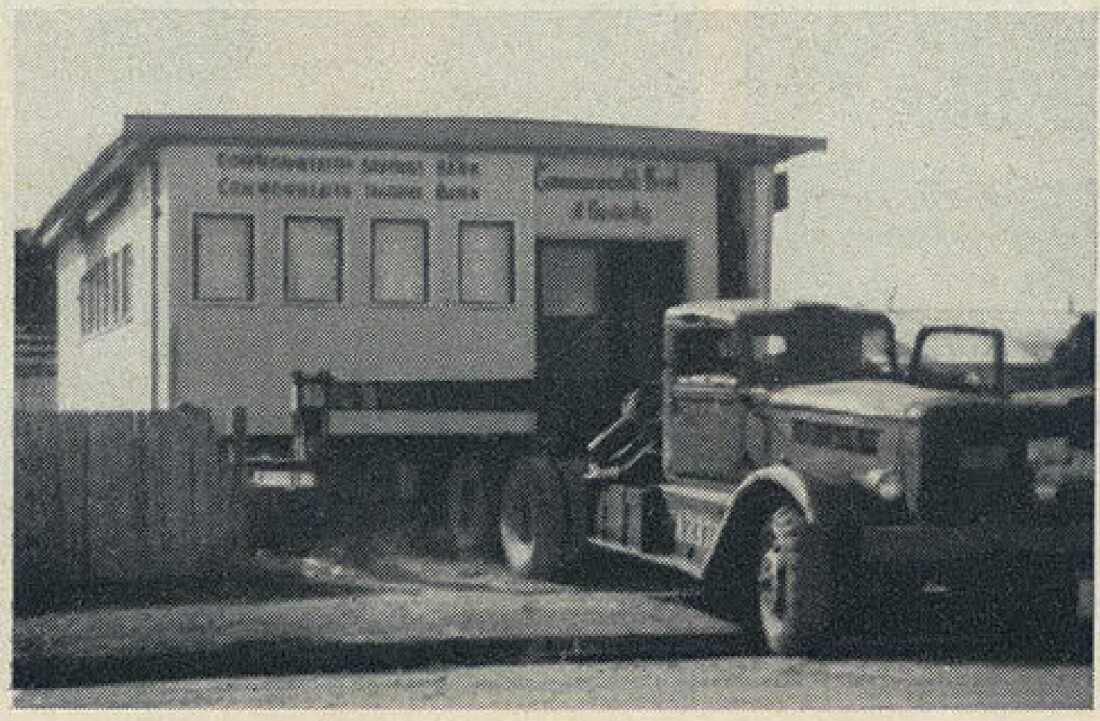
The Third Building 1964 - The Full Branch (Brick Building)

The architect for the new premises was attached to the Department of Works. The contract, estimated at £19,138/6/8, was awarded to William Smurthwaite from East Maitland. Construction of the new branch building was completed on 7 August 1964, and the old, prefabricated building was disposed of, to allow construction of the new manager’s residence to begin.

William Smurthwaite was born in 1907 in Durham, England, and arrived in New South Wales in 1913. He was known as Bill. He lived with his family at Homeville, near Maitland, where his father was a signalman. He was married in 1939 at Kurri Kurri to Mavis Marie Chaney, born 1913 in Queensland, daughter of William Chaney and Pauline Sophia Widmer. After marriage, they lived at Lindsay Street, East Maitland, but by 1949 they had moved to Nerang Street, East Maitland. William was a carpenter and builder. Some of his projects in the 1950s included work for the Housing Commission of NSW (at East Maitland), the Department of Education (at Quirindi), private residences (East Maitland), and the Church of England Grammar School (Morpeth). He had retired by 1980. Mavis died in 1992 and William in 1999.

The new branch building was a single-storied brick building with the main frontage (of brickwork and glazing) on Station Street. It had an open-look counter and tellers’ boxes. The counter was 27 feet 6 inches in length. The public space measured 450 square feet, the working space 440 square feet, the manager’s office 115 square feet, the strongroom 118 square feet, and the storeroom 50 square feet. Also provided were toilets and a staff room. Fluorescent lighting was installed throughout.

The new bank manager’s residence at Weston was completed on 14 December 1964 and faced First Street. It comprised three bedrooms and ample living and entertainment areas. The following photographs were taken on 26 August 1964.

In 1966, the Bank actively supported the introduction of decimal currency.

On 3 November 1968, Ronald Eric Cram took over as manager at Weston. He served until 24 January 1983. He was born in 1923 at Young, New South Wales, son of Robert Cram and Matilda Lucy Rule. By 1941, he was working as a bank officer at the Commonwealth Bank at Young. In that year, he signed an attestation form to join the armed forces, but perhaps that did not work out. Another enlistment form was signed in June 1943, when he was described as 5 ft 7 in tall, with blue eyes, and fair hair. He served in Balikpapan, Indonesia, from May 1945 to March 1946. He was married in September 1946 at Maryborough, Queensland, to Beth GEE. They had two sons – Wayne and Darryl. Ronald was discharged in October 1946. By 1949, they had moved to Darlinghurst, Sydney. By 1954, they were back in Queensland, with an address at Ashgrove, Brisbane. Ronald was working at the Queen Street, Brisbane, branch the following year. In 1958, they were at Laidley (between Ipswich and Toowoomba), and by 1963 at Lismore, NSW. In 1968, they were at Darwin Street, Cessnock. After his appointment at Weston, they lived in the bank residence at 51 First Street with their sons. By 1980, they had moved to Metford. Ronald died at Newcastle in 1990, and Beth at Belmont in 2016.

During the 1970s, the Bank diversified its business into insurance and travel. It established a finance company (CBFC), in 1974. The major trading banks also created the first credit card, Bankcard, in Australia in 1974.22

Automated teller machines (ATMs) were rolled out by Australian banks from May 1980.23

The 1980 Electoral Roll records that 51 First Street, Weston, was occupied by Charles Joseph Higgins, self-employed, and Patricia Ann Higgins. They were probably renting from the Bank. At the time, Ronald Eric Cram, the bank manager, was living at Metford, and evidently commuting to Weston.

1983 - The Sub-Branch

On 24 January 1983, the status of the branch in Weston was downgraded to Sub-Branch (now known as a Service Centre). The new sub-branch reported to the Kurri Kurri branch.24 Sub-Branch status meant that a manager was no longer stationed at the Weston branch. This change seems to have prompted the subdivision of the allotment, which occurred in the period 29 May 1984 to 25 June 1985. The subdivision was registered as Deposited Plan 712222, which mentioned L C Hollis (possibly Laurence Christopher Hollis, solicitor, of Kelyville near Castle Hill, Sydney) and E B Randall.25 It is likely that the title also converted from Old System to Torrens Title at that time. The First Street allotment could have been sold as a separate title any time afterwards.

EFTPOS technology was introduced in 1984.26 MasterCard was offered in 1984 and Visa in 1993.27 Between 1991 and 1996, Keating’s Government fully privatised the Bank.28

Patronage of the bank sub-branch in Weston was on the decline between 1983 and 1991. It was clear that the bank was aware of this situation. This period also included the worldwide stock market crash of October 1987. The Weston branch placed an advertisement in the local primary school’s magazine in November 1991.29

“Support Your Local Bank. Which Bank? Commonwealth Bank. 42 Station St, Weston.”

In the mid-1990s, ecommerce commenced, being facilitated by widespread acceptance of credit cards and the development of SSL encryption. Telephone banking was also introduced.30

1994 - Closure

In January 1994, the editor of the Newcastle Herald31 gave an opinion of the decline of Weston at the time when the town was threatened with the closure of its branch of the Commonwealth Bank.

“Weston’s Withdrawal.
It is difficult not to feel sorry for Weston. The proposed closure of its branch of the Commonwealth Bank, the small Coalfields town’s only bank, is the latest chapter in a tale of decay that has spanned at least a decade. Further darkening the gloom of business decline in an ageing community, recent years have brought the loss of the rail line, the closure of the police station and threats to close the post office. So for many Weston residents it seems the very idea they might now lose their bank is intolerable, as if it would mark not merely the latest but the closing chapter in the town’s decline.
Despite spirited pleas by the Weston community, Cessnock City Council and Mr Eric Fitzgibbon, MHR Hunter, and despite a Cessnock council offer to transfer a $29 million account from Cessnock to Weston, the Commonwealth Bank seems firm in its decision to close the Weston branch on February 11. Even a threat by the council to withdraw its custom from the Commonwealth Bank if the closure goes ahead has failed to shake the bank’s resolve. The people of Weston have taken to the ramparts, vowing that they won’t allow the closure. The Cessnock council, too, is talking bravely, with the Mayor of Cessnock, Cr Callaghan, declaring that the battle with the bank is one the council intends to win. But despite the good intentions, the chance of victory seems remote.
While the proposed closure of the bank suggests the continuing decline of the once-thriving mining town, that decline has not gone unchallenged by residents determined to reverse the trend. Ten years ago, Weston traders, acknowledging that the town centre was dying, formed a chamber of commerce in a bid to revive it. At about the same time it was suggested that the ailing shopping centre could be revitalised by redirecting traffic through Cessnock Rd and transforming Weston’s main street, Station St, into a mall. That idea was revived and expanded upon in 1991, when a residents’ committee, inspired to make an attraction of the town’s Welsh and Geordie heritage and its mining history, looked to follow the lead of popular Hunter tourist towns such as Morpeth and Wollombi.
But dreams and determination have not been enough, and Weston remains unable to seriously propose to the bank that it should stay put because boom times are just around the corner. Weston can plead only that the aged and disadvantaged among its population could be inconvenienced if the branch closes, an argument unlikely to be more persuasive than the hard fact that the branch is unprofitable.
Commercial Reality.
According to the Commonwealth Bank’s State general manager, Mr Dick Perkins, the Weston branch is not a viable business and has not been for some time, and Mr Perkins has said the same of other branches in this region. In 1992 he declared the Murrurundi branch unviable, and, despite a determined protest campaign by residents, the branch was duly closed. Last month, Mr Perkins confirmed that the bank’s Cooks Hill sub-branch was marked for closure because it too had become unviable.
The viability of a branch is determined by the volume and quality of transactions, the number of accounts opened and closed and the social ramifications of closure. But while that last criterion might give Weston some hope it is unlikely to override cold commercial reality.
As for the Cessnock council’s $29 million carrot, it seems to have been offered too late. The bank, which according to Mr Perkins had given the closure ‘long and careful consideration’, had already made up its mind. The offer might also have been unwise. Had it been accepted, transfer of the council’s account from Cessnock to Weston might have risked the viability of the Cessnock branch.
It is sad but reasonable to consider that in the same way communities acquire amenities as they grow, the reverse also applies. If there is a sense of inevitability about the closure of the bank at Weston, it may be a reflection of the apparent inevitability of the further decline of Weston itself.”

The sub-branch was closed on 11 February 1994. Current and former residents have shared their memories.

“Weston was dealt a cruel blow in 1994 with the closure of its Commonwealth Bank. Two days after he was named the inaugural Freeman of the City of Cessnock, Edward John 'Coogan' Frame, who was born in Weston in 1917, the son of Edward John ('Bluey') and Catherine Frame, was taken into custody by the police when he and some of his retired miner mates arranged a protest at the Commonwealth Bank after being unable to persuade the CBA bureaucrats to reconsider closing the bank. (He can be seen in the protest photograph with the megaphone.) Coogan Frame decided that if that were to be the end of the town’s financial institution, then he would make sure it got a good funeral! He organised a coffin, six pallbearers and a lone piper for the event. After addressing the hundreds of local residents in the crowd, persuading them to not tear up their bankbooks, he and a few of his loyal following staged a sit-in at the bank. Coogan Frame said in frustration at the time: 'We've got a Railway Station with no trains, a Police Station with no policemen, we almost had a Post Office with no stamps and now we will have a Bank with no money!' Who can ever forget that statement!”32

The office building, at 46-48 Station Street, Weston, was sold on 16 December 2009 for $103,200.33 It was then described as occupying 810 m2 with internal space measuring 100 m2. The residence, at 51 First Street, Weston, was sold on the same date, and for $154,800.34 It was then described as occupying 501 m2 with internal space measuring 125 m2.

Staff members remembered by current and former Weston residents include (in no particular order) - Ann Day of Fifth Street, Weston; Peter Mallam; Elizabeth Holt; Allan Watson of Government Road, Weston; Sue Gray; Elizabeth Kirkup; Walter Edgell; Ron Porteus of Elrington; Allan Taylor; Jeff Richardson; Paul Callaghan; and Garth Anderson.35

After 1994

Internet banking was introduced in 1995.36

The ninth Chair of the Board of the Commonwealth Bank of Australia, John Ralph, served from 1 November 1999. He was the third cousin twice removed of two residents of Weston at that time – Mrs Phyllis M Meadows and her brother Mr Albert J Williams.37

Mobile banking was introduced in the 2010s.38

In conclusion, the history of the Commonwealth Bank in Weston coincided initially with a period of maximum prosperity, when local production of coal was booming in the late 1940s. The closure of the mine just ten years later dealt a fatal blow, but the decline was prolonged over the following three decades. The downgrading of the branch’s status in 1983 presaged the inevitable closure in 1994. While the pain of the closure was felt acutely by residents at the time, subsequent advances in information and communications technology has replaced many functions previously carried out in person at the branch with the convenience of Internet and mobile banking. The history of the bank in Weston also mirrored the experience of other commercial activities in the town. While Weston might now be a quieter place in terms of local trade, the revolutionary changes in banking and commerce, brought about by the information age, have mostly effectively counterbalanced the changes in the town.

Bibliography

Ancestry.com.au.
Cessnock Eagle and South Maitland Recorder newspaper.
Clark, Manning, “A Short History of Australia”, Illustrated 2nd Edition, 1981, Macmillan Company of Australia Pty Ltd, South Melbourne.
Commissioners of the Rural Bank of New South Wales, “A Brief History of Australian Banking”, 1936.
Commonwealth Bank of Australia Group Archives.
Falk, Julie Frame, “Weston NSW History & Heritage”, https://sites.google.com/site/westonnswaustralia.
Findagrave.com.
Gollan, Robin, “The Commonwealth Bank of Australia: Origins and Early History”, Canberra, 1968.
National Archives of Australia.
Newcastle Herald newspaper.
Newcastle Morning Herald and Miners’ Advocate newspaper.
NSW Land Titles Office, Historical Land Records Viewer.
NSW Registry of Births Deaths and Marriages.
Ralston, Basil, “My Ten Years in Weston, 1926-1936”, 1989, Bob James, Tighes Hill.
Ryerson Index, https://www.ryersonindex.org.
Singh, Supriya, “The Bankers: Australia’s leading bankers talk about banking today”, 1991, Allen & Unwin, North Sydney.
Ward, Russell, “Australia since the coming of man”, 1987, Macmillan Company of Australia Pty Ltd, South Melbourne.
Weston Public School, “The Weston Warbler”, November 1991, Vol 2, No 2.
Wikipedia, “Commonwealth Bank”, https://en.wikipedia.org/wiki/Commonwealth_Bank.
Wikipedia, “Banking In Australia”, After Federation, https://en.wikipedia.org/wiki/Banking_in_Australia#After_federation.

Acknowledgements

Valuable assistance and historical source materials were kindly provided by Mr Steven Politzer, Group Archivist, Commonwealth Bank of Australia Group Archives, Eveleigh, NSW. Mrs Julie Frame Falk and Ms Lisa Williams kindly allowed reproduction of their original images. Research assistance was also provided by the Society of Australian Genealogists, the Royal Australian Historical Society, and Newcastle Region Library.

Notes

1 Commissioners of the Rural Bank of New South Wales, page 21.
2 Newcastle Morning Herald and Miners’ Advocate, Sat 25 Jun 1904, pages 4 and 6, http://nla.gov.au/nla.news-article138242671 and http://nla.gov.au/nla.news-article138248806.
3 Newcastle Morning Herald and Miners’ Advocate, Mon 25 Mar 1907, page 6, http://nla.gov.au/nla.news-article136613961.
4 Falk.
5 Singh, chronology, page 7.
6 Clark, page 181.
7 Wikipedia, “Commonwealth Bank”.
8 Ward, page 162.
9 Commissioners of the Rural Bank of New South Wales, page 22.
10 Wikipedia, “Commonwealth Bank”.
11 Commonwealth Bank of Australia Group Archives, A0023, S0009, 1BP-2-645-[1-5], Weston, NSW - Property Files and Photographs, 1945-65.
12 Ancestry.com.au; NSW Registry of Births Deaths and Marriages.
13 NSW Land Titles Office, Historical Land Records Viewer, Vol 1965 Folio 214.
14 Cessnock Eagle and South Maitland Recorder, Fri 18 Jan 1946, page 5, http://nla.gov.au/nla.news-article100027583.
15 Commonwealth Bank of Australia Group Archives, A0023, S0009, 1BP-2-645-[1-5], Weston, NSW - Property Files and Photographs, 1945-65.
16 Commonwealth Bank of Australia Group Archives, A0023, S0009, 1BP-2-645-[1-5], Weston, NSW - Property Files and Photographs, 1945-65.
17 NSW Land Titles Office, Historical Land Records Viewer, Book 902 No 44, Book 1477 No 626, Bk 2080 No 27; Ancestry.com.au.
18 Ralston, Chapter 2. Note that Aberdare Street is now Cessnock Road.
19 Wikipedia, “Commonwealth Bank”; Singh, chronology, page 13.
20 Commonwealth Bank of Australia Group Archives, A0023, S0009, 1BP-2-645-[1-5], Weston, NSW - Property Files and Photographs, 1945-65.
21 Commonwealth Bank of Australia Group Archives, A0050, S0270, 1ST-23-2-53, Bank Notes, July 1964, Series 2, Volume 5, No. 7, Pg. 3.
22 Wikipedia, “Commonwealth Bank”; Singh, chronology, page 14.
23 Wikipedia, “Banking in Australia”, After Federation; Singh, chronology, page 14.
24 Commonwealth Bank of Australia Group Archives, A0050, S0270, 1ST-23-2-53, Bank Notes, July 1964, Series 2, Volume 5, No. 7, Pg. 3.
25 NSW Land Titles, DP 712222.
26 Wikipedia, “Banking in Australia”, After Federation.
27 Wikipedia, “Commonwealth Bank”.
28 Wikipedia, “Commonwealth Bank”.
29 Weston Public School, “The Weston Warbler”, p 14.
30 Wikipedia, “Banking in Australia”, After Federation.
31 Newcastle Herald, 22 Jan 1994, p 8.
32 Falk.
33 Onthehouse.com.au.
34 Propertyvalue.com.au.
35 Falk.
36 Wikipedia, “Banking in Australia”, After Federation.
37 The late aunt and father of the author.
38 Wikipedia, “Banking in Australia”, After Federation.

Sunday, January 28, 2024

Elizabeth KING - The Facts of Her Birth, Marriage, and Death

Elizabeth KING was one of the four daughters of Capt Philip Gidley KING RN, Lieutenant Governor of Norfolk Island, and later 3rd Governor of the Colony of New South Wales, and his wife Anna Josepha COOMBE. She appears in numerous online family trees, with wildly varying unsourced details of her birth, marriage, and death facts.

Some of those trees state that she was born in 1796, some in 1797. Some give the exact date as 10 Feb 1797, while others give 2 Oct 1797. The place of birth is sometimes stated to be Routh (Yorkshire, England); Sulawesi (Indonesia, specifically Central Sulawesi, also known as Sulawesi Tengah); Tengah, Central Kalimantan (Indonesia); Greenwich (Kent, England); at sea; Somerset (England); on board Contractor or Britannia; Indiana (USA); Norfolk Island (Australia); East Carroll (Ohio, USA); Richmond (Surrey, England); Bideford (Devon, England); and The Shoe (Wiltshire, England). This absurd situation surely highlights the imprudent practice of copying the work of others without bothering to cast a critical eye. Similar lists of dates and places of her marriage and death are also to be found, but let us not belabour the point with further useless detail.

Fortunately, good quality evidence is readily available to clarify the details of the events.

Author Marnie BASSETT wrote in her book The Governor's Lady: Mrs Philip Gidley King (Oxford University Press, 1940, London, page 34) that in April 1796 the KING family sailed aboard the Britannia and then the Contractor for England, and that during the voyage, daughter Elizabeth was born. The family evenually arrived in England in May 1797. (This source is cited on the Wikipedia page for Mrs KING.) BASSETT's statement omits the finer details.

Shortly after arriving in England, Capt KING wrote a letter to Secretary NEPEAN. Dated 9 May 1797, the letter gives the following details:

"The Britannia being chartered by Governor HUNTER to return to England, he allowed that ship to call for me at Norfolk Island.  I embarked from thence the 22nd last October, arrived at the Cape the 15th, and left it the 26th Jan'y, in the Contractor, East India ship, and arrived at Plymouth the 6th inst't."

Source: HRNSW, V3, p 206, image 250, http://nla.gov.au/nla.obj-359069148 (image attached)

The "Cape" referred to was the Cape of Good Hope. Thus, we have some key dates for the timeline:

22 Oct 1796, departed Norfolk Island per Britannia

15 Jan 1797, arrived Cape of Good Hope

26 Jan 1797, departed Cape of Good Hope per Contractor (an East India Company ship)

6 May 1797, arrived Plymouth, England

Elizabeth was baptised 16 months later. The record reads:

"September 1798... Baptised 25 Elizh Daugr of Philip Jidley King a Captn in the Royal Navy & Anna Josepha Born Feb 10 1797"

Source: London, England, Church of England Baptisms, Marriages and Burials, 1538-1812, Greenwich, St Alfege, 1784-1812, image 83 of 140, ancestry.co.uk (image attached)

Thus, the correct date of birth is 10 Feb 1797, and placing this into the timeline of the voyage, we see that Elizabeth was born at sea aboard Contractor after departing the Cape of Good Hope and prior to arriving at Plymouth. This leg of the voyage took one hundred days, with the birth taking place on the fifteenth day, so an approximate place of birth can be estimated as Lat 20 S Long 6 E, off the coast of Namibia in the South Atlantic Ocean.

The Contractor's journals, ledgers, pay books, deck log, imprest book and absence book might be included in the archives of the British Library's Asian and African Studies section (as cited in The National Archives' catalog reference L/MAR/B/319), so it is possible that the birth might have been noted along with precise coordinates.

Details of her marriage are easily found online. The document reads:

"Marriages solemnized in Christ Church, in the Parish of St Mary-le-bone, in the County of Middlesex, in the Year One Thousand Eight Hundred and twenty-nine... Charles RUNCIMAN of the Parish of Paddington in the County of Middlesex a Widower and Elizabeth KING of the District-Rectory of Christ Church in the Parish of St Mary-le-bone in the same County a Spinster were married in this Church by Licence this First Day of October in the Year One thousand eight hundred and twenty-nine.  By me W J HUTCHING MA Curate.  This Marriage was solemnized between us Chas RUNCIMAN, Elizabeth KING (both signed), In the Presence of Francis RUNCIMAN, Benjn Edwd HALL, Sarah E G HALL, A J KING, T STILWELL Jr.  No. 82."

Source: London, England, Church of England Marriages and Banns, 1754-1938, Westminster, Saint Marylebone, Marylebone Road, 1825-1833, image 91 of 171, ancestry.co.uk (image attached)

Details of her death and burial are also readily available. Firstly, notices were published in the press:

"Died... On the 31st ult. at Dorking, Elizabeth, the wife of Charles RUNCIMAN, Esq. of Oxford-terrace, Edgeware-road."

Source: Morning Herald (London), 3 Sep 1831, page 4, findmypast.co.uk (image attached)

"Died... Aug. 30, at Dorking, Elizabeth RUNCIMAN, of Oxford-terrace, Edgware-road."

Source: Saint James's Chronicle, 3 Sep 1831, page 3, findmypast.co.uk (image attached)

The burial register reads:

"Burials in the Parish of Paddington in the County of Middlesex in the Year 1831...
No - 1930
Name - Elizabeth RUNCIMAN
Abode - Dorking, Surry (sic)
When buried - [September] 5
Age - 34
By whom the Ceremony was performed - Do [ditto for W K CLAY Curate]"

Source: London, England, Church of England Deaths and Burials, 1813-2003, Westminster, St Mary, Paddington Green, 1813-1832, image 418 of 447, ancestry.co.uk (image attached)

Note that William Keatinge CLAY was appointed as curate at Greenwich on 24 Dec 1823.

Source: theclergydatabase.org.uk

The attached illustration is of the family about 1800, shortly before their departure for New South Wales, where Capt KING succeeded Governor HUNTER. The illustration is based on a watercolour drawing by R DIGHTON.

Source: Illustrated Sydney News, Sat 19 Dec 1891, page 20, http://nla.gov.au/nla.news-article63613489

So in summary, we can now state the facts about Elizabeth.

Birth - 10 Feb 1797 on board the Contractor, in the South Atlantic Ocean, probably off the coast of Namibia

Arrival - 6 May 1797 at Plymouth, England

Baptism - 25 Sep 1798 at St Alfege, Greenwich, Kent, England

Marriage - 1 Oct 1829 at Christ Church, Saint Mary-le-bone, Middlesex, England

Death - 30 or 31 Aug 1831 at Dorking, Surrey, England

Burial - 5 Sep 1831 at St Mary, Paddington, Middlesex, England

Sadly, if hopes are held that corrections will be made to hundreds of erroneous online trees, disappointment will be the likely outcome.

Friday, September 15, 2023

South Maitland Coalfield Mechanics' Strike of July 1916

On 17 July 1916, mechanics working at Abermain No 1, Pelaw Main, Richmond Main, and Stanford Merthyr Collieries refused to work, thus causing the mines to be idle. The mechanics protested against "the contemptuous manner in which their requests to the proprietors for a conference" was treated. Their union, the Colliery Mechanics' Association, which had 700 members, had made a claim to the wages board in June, but it had been rejected. Subsequent requests for a conference were ignored by the proprietors.

Two days later, the whole of the fourteen collieries on the South Maitland coalfield were thrown idle, in support of the mechanics. Further dissatisfaction was noted in regard to the South Maitland District Colliery Deputies' Association and other matters. As a result of the action of the mechanics, 4,700 men were on strike, and a mass meeting was held. The men decided to remain on strike until the proprietors attended a conference with a satisfactory outcome.

The Mechanics included surface hands, labourers, weighmen, colliery railway guards, fitters' assistants, storemen, tool sharpeners, rope-splicers, cable-hangers, boilermakers' assistants, pipemen, carters, horse-shoers, grooms, gangers, fettlers, concrete mixers, carpenters' assistants, bricklayers' labourers, painters, blacksmiths and their strikers, and fitters. Associated unions were also involved in the action. A few mines had already started paying the rates requested, resulting in disparity among the workers in the various mines.

A conference took place on 21 July in Newcastle, between the Colliery Proprietors' Association and the Colliery Mechanics' Association. The workers were represented by Mr W WALLER (union official), and a group of men from the various mechanics' occupations. An adjournment was made until 24 July. The following day, the proprietors made an offer to increase wages. The Cessnock Mechanics held a combined meeting on 26 July, and accepted the offer. Another meeting, in the Kurri district on 27 July, also accepted the offer. At a further meeting on 28 July, the men of East Greta Colliery rejected the offer. Thus, thirteen of the fourteen collieries had accepted. Mr WALLER, and the executive, overrode the East Greta men's rejection, thus securing "by conciliation what had been denied by a wages board" and declaring it a "victory for the men". Mr WALLER was praised as "a moderate in industrial matters who regards a strike as the last weapon to be used with reluctance".

Sources:

Newcastle Morning Herald and Miners' Advocate, Tue 18 Jul 1916, page 5, http://nla.gov.au/nla.news-article133877103

Tamworth Daily Observer, Wed 19 Jul 1916, page 2, http://nla.gov.au/nla.news-article116826191

Maitland Daily Mercury, Sat 22 Jul 1916, page 7, http://nla.gov.au/nla.news-article122173454

Sydney Sun -

Thu 20 Jul 1916, page 1, http://nla.gov.au/nla.news-article223379861

Mon 24 Jul 1916, page 5, http://nla.gov.au/nla.news-article223375575

Thu 27 Jul 1916, page 6, http://nla.gov.au/nla.news-article223383405

Fri 28 Jul 1916, page 7, http://nla.gov.au/nla.news-article223369538

Sat 29 Jul 1916, page 5, http://nla.gov.au/nla.news-article223374529

Sunday, September 10, 2023

Rich Cousin, Poor Cousin

Part 1 of 12

Early in 2021, I decided to try to fill a gap in my paternal grandmother's pedigree (see below). I had the surnames of all of her great-grandparents except for one - namely Mary (Mrs Robert BURN) of Spittal, Northumberland, England. This research brick wall had stumped me for a long time. Mary is one of my 3 greats grandmothers, and the only one of all of my 32 x 3 greats grandparents whose surname was unknown. But... I have finally solved it! And it's an amazing story! It adds to the explanation of how my great-grandfather, Robert "Bobby" ROBERTS 1852-1933 (the champion pennyfarthing cyclist from Cramlington, Northumberland, England) was able to afford to come to Australia in 1882.

Part 2 of 12

Here's what I knew about Mary (unknown surname) before the latest discoveries.

Mary was born about 1805 at Spittal, near Berwick on Tweed. Her first partner was Robert BURN 1802-1832. If they married, it must have been about 1825, but I haven't found a record. They had 4 or 5 children - Phillis ca 1826 (my 2ggm), Thomas 1828, Elizabeth 1830, Mary 1832, and possibly Robert b ca 1831. Robert BURN was a pitman, and he died in 1832 aged 30 years, and was buried at Tweedmouth. The family's religious denomination was United Presbyterian, at least for a time.

On the 1841 census, she was Mary BURN living at Front Street East, Spittal, with children Thomas 13, Elizabeth 11 and Mary 7, next door to her brother-in-law, Thomas BURN, publican (and his first wife Anne).

By the 1851 census, Mary had moved to Cramlington, Tynemouth district, and was listed as Mary HOPKINSON, wife of John HOPKINSON, hawker from Birstall, Yorkshire. Her son Thomas BURNS (sic) was with them. I doubt that Mary and John married, as I can't find a record.

On the 1861 census, Mary and John HOPKINSON were living at 9 Chatham Place, Newcastle upon Tyne. He was a woollen cloth weaver, born Gomersal (which is near Birstall).

John HOPKINSON died June qtr 1863 Newcastle upon Tyne, aged 63y.

Mary died 26 Feb 1865 at 3 Richmond Place, Gibson Street, Newcastle upon Tyne. I have the death certificate, it says she was "widow of John HOPKINSON, hawker in drapery". The informant was Alexander McFARLANE, of that address. Alexander was her son-in-law, husband of Elizabeth BURN b 1830.

She was buried 1 Mar 1865 at Seghill, as Mary HOPKINSON.

Part 3 of 12

Now, to the new evidence about Mary. First, this newspaper death notice -

"At Newcastle... on the 26th ult... In Richmond Place, on the same day, aged 61, Mary, widow of Mr John HOPKINSON."

Source: Newcastle Courant, 3 March 1865, page 8, findmypast.co.uk

Part 4 of 12

A Puzzling Probate Record

I knew that Mary HOPKINSON formerly BURN nee unknown had died on 26 February 1865 at 3 Richmond Place, Gibson Street, Newcastle upon Tyne. The informant on the death certificate was her son-in-law, Alexander McFARLANE, husband of Elizabeth BURN.

I thought I would see if Mary's estate was administered, and found the attached puzzling probate record in the National Probate Calendar.

This is an index to probates and letters of administration granted to executors and next of kin, by the various probate registries in England and Wales (which were established in 1858).

This Calendar entry is for 8 June 1865, and states that a Mary HOPKINSON died on 1 April 1865 at Newcastle-upon-Tyne. Probate was granted to one William TATE of Cramlington, the executor. My Mary had lived at or near Cramlington from the early 1840s until the end of the 1850s.

I decided to send off for a copy of this will and probate, in spite of the date of death being different, and that I had no idea who William TATE was. I did know, from the deaths index, that there was only one Mary HOPKINSON death registered in Newcastle around that time - and that was my Mary. What would this odd probate record reveal? It took four days to arrive, costing just $AUD2.85.

Part 5 of 12

Will of Mary HOPKINSON, 26 November 1864

The will arrived on 5 June 2021. I have attached the image, and here is my transcript:

"This is this last Will and Testament of me Mary HOPKINSON of Newcastle on Tyne Widdow which I make in manner and form following.

I appoint William TATE Overman Cramlington Colliery in the County of Northumberland Executor and trustee of this my Will as it regards my household furniture

I bequeath to my Daughter Philis ROBERTS my bedstead and mattress five chairs and small chest.

I bequeath to my son Thomas BORNE (sic) my clock press large table and large chair.

I bequeath to my Daughter Elizabeth BORNE (sic) my Chest of drawers and torneover table.

I bequeath to my Daughter Mary HARRISON my No 2 Clock teak (?) boulster two feather pilles and dreser and shelf and if there is anything omitted to be equally devided, my apprel to be equelly devided amongst my three Daughters, and being a legatee in the estate of the late Margreat MATHERS naw settling in Alnwick, I appoint William TATE my trustee to recive my legacie and after payment of all my just debts to devide the remander equelly amongst my childern Philis ROBERTS Thomas BORNE Elizabeth BORNE and Mary HARRISON

and I revoke all other Wills and declare this to be and contain my last Will and Testament.

In witness whereof I have hereunder set my hand this twenty sixth day of November one thousand eight hundred and sixty four.

Mary HOPKINSON.

Signed by the testatrix and declared by her to be her last Will and Testemant in the presence of us who in her presence and at her request and in the presence of each other have herunto subscribed are names as witnes.

Joseph TIPLADY

Joseph PATTERSON"

This is definitely my Mary. It names her four children, all previously known to me - Phillis BURN (wife of James ROBERTS and mother of Robert "Bobby" ROBERTS, the champion cyclist who came to Australia); Thomas BURN; Elizabeth BURN (later wife of Alexander McFARLANE); and Mary BURN (wife of Matthew HARRISON). One of the witnesses, Joseph TIPLADY, was later married to Phillis (after James ROBERTS died in 1869). The spelling in the will is not very accurate! But, the most surprising section was the part stating that Mary was "a legatee in the estate of the late Margreat MATHERS naw settling in Alnwick". The name Margaret MATHER was new to my research, and raised further questions. Who was she and when did she die? How was she connected to Mary? How much did Mary receive due to this legacy? And was William TATE somehow connected to Mary or to Margaret MATHER? This sent me off to do further research.

Part 6 of 12

Mary's Death and Probate

Mary HOPKINSON formerly BURN nee unknown died on 26 February 1865 at 3 Richmond Place, Gibson Street, Newcastle upon Tyne. She died at the home of Alexander McFARLANE who was the fiance of Mary's daughter Elizabeth BURN (they married about August that year). The cause of death was ovarian dropsy (some years) and operation for removal of tumor following peritonitis (1 week).

Just over three months later, William TATE, colliery overman, of Cramlington Colliery, the executor named in Mary's will, was granted probate over her estate. This was dated 8 June 1865, and erroneously stated that she died on 1 April 1865. The probate documents state that her estate was valued at under 200 pounds. This would have included the expected legacy from Margaret MATHER's estate. Perhaps the bulk of the 200 pounds came from Margaret, but as there is no inventory or account of the administration of Mary's estate, it is a matter of conjecture.

Mary had four children, so each would have received an inheritance of about 50 pounds when her estate was finalised. One of the children was Phillis ROBERTS nee BURN, mother of Robert "Bobby" ROBERTS (the champion cyclist who emigrated to Australia in 1882). When Phillis died in 1891, she had two other living children - Mary Burn WALLACE nee ROBERTS (of Hebburn, Durham, England); and Elizabeth WORTHLEY nee ROBERTS (of Hindmarsh, Adelaide, South Australia). Phillis's oldest child, James ROBERTS, had died at Blyth, Northumberland, England in 1880, leaving 5 children. It seems that Phillis did not make a will, but assuming that she preserved the capital of the 50 pound inheritance from her mother (Mary HOPKINSON), then that would have been divided between her children. So, Robert "Bobby" ROBERTS should have received one quarter, about 12 and a half pounds. Whether that was sent to him in Hamilton, New South Wales, is not known. However, Robert was living on the Commonage at Hamilton at the time, so perhaps such an inheritance helped him to pay off his allotment on the Commonage when it was converted to a proper title in 1899. He sold that property in 1904 to buy his first house in Weston (in Fourth Street) in 1908.

Transcripts of the two probate documents:

On the eighth day of June 1865, the Will of Mary HOPKINSON late of the Town and County of Newcastle upon Tyne Widow deceased, who died on the first day of April 1865, at Newcastle upon Tyne aforesaid was proved in the District Registry attached to Her Majesty's Court of Probate at Newcastle upon Tyne by the Oath of William TATE of Cramlington Colliery in the County of Northumberland Colliery Overman, the Executor as in the said Will mentioned, he having been first sworn duly to administer. Effects under 200 pounds. No leaseholds. Extracted by Wilson and Middlemas of Alnwick, Solicitors.

At Newcastle upon Tyne, on the eighth day of June 1865 the Will of Mary HOPKINSON late of the Town and County of Newcastle upon Tyne Widow deceased, who died on the first day of April 1865 at Newcastle upon Tyne aforesaid, was proved by the oath of William TATE, the Executor as in the said Will mentioned, he having been first sworn duly to administer. Sworn under 200 pounds.

Part 7 of 12

Change of Fortune!

As I mentioned, my Mary was born about 1805 at Spittal, and I found from her will that she was due to receive an inheritance from a Margaret MATHER from Alnwick. I decided to look in the newspaper files for Margaret MATHER, and found the following astounding item:

"Welcome Change of Fortune. - By the death of an old lady at Alnwick, a number of poor people at Spittal have become possessed of a large sum of money, and to them such an acquisition of wealth must prove a most welcome boon. The total sum bequeathed to these poor people in property and otherwise is variously estimated at about 50,000 pounds, and that, it is stated, will be divided among ten families. The deceased's name is Margaret MATHER."

Source: Southern Reporter, 30 Oct 1862, p4, findmypast.co.uk

50,000 pounds was an enormous fortune in those days! So, my Mary must have belonged to one of the "ten families" from Spittal.

Part 8 of 12

Not 50,000 pounds, but 10,000 pounds!

It seems that the 30 October 1862 newspaper report regarding the value of the estate of Miss Margaret MATHER was not reliable. Another report appeared shortly afterwards:

"We have been informed on official authority that the effects of the late Margaret MATHER, Alnwick, are under 10,000 pounds, instead of the large sum previously reported."

Source: Berwick Advertiser, 1 Nov 1862, p3, findmypast.co.uk.

There was also a notice regarding the estate:

"Margaret MATHER, Deceased. Notice is hereby given, that all Persons having Claims against, or being indebted to, the late Margaret MATHER, of Alnwick in the County of Northumberland, Spinster, deceased, are requested forthwith to send in their respective Claims or to pay their respective Debts, to WILSON & MIDDLEMAS, Solicitors to the Executors, Bondgate, Alnwick. Alnwick, 27th October, 1862."

Source: Newcastle Chronicle, 1 Nov 1862, p1, findmypast.co.uk.

The solicitors, Wilson and Middlemas, were the firm that looked after my Mary HOPKINSON's estate.

Part 9 of 12

Not 10,000 pounds, but 9,000 pounds!

Even the correction in the press was incorrect! Here is the actual probate record for the estate of Miss Margaret MATHER:

"Proved at London 14th Novr 1862 by the oaths of William McDougal and Thomas Duncan the executors to whom admon was granted."

"On the 14th day of November 1862, the will of Margaret MATHER late of Alnwick in the county of Northumberland spinster deceased, who died on the 22nd day of October 1862, at Alnwick aforesaid was proved in the Principal Registry of Her Majesty's Court of Probate, by the Oaths of William McDougal of Alnwick aforesaid gentleman and Thomas Duncan of same place auctioneer the Executors named in the said will they having been first sworn duly to administer."

Part 10 of 12

The Will of Miss Margaret MATHER

Miss Margaret MATHER of Alnwick, Northumberland, made and signed her last will and testament on 21 October 1862. She died later that same day. She had no living parents, siblings, nieces or nephews, so decided to leave her 9,000 pound fortune to a large number of cousins, and some acquaintances and associates. She mentioned more than 30 people in her will! She appointed, as executors and trustees, Mr William McDOUGAL, gentleman, and Thomas DUNCAN, auctioneer, both of Alnwick.

Specific bequests included freehold houses, a shop, a garden, and other freehold property in Alnwick, Embleton, Glanton and elsewhere; cash; and very valuable shares in the Alnwick Gas Company. In addition to all of that, the bulk of her personal and real estate and effects were to be sold. The resulting cash was to go to her cousins, descendants of the JOHNSON family of Spittal, Northumberland.

One tenth was to be invested, with the interest to be paid to her cousin William JOHNSON every six months during his lifetime - he died two years later in 1864 aged 83 years. The other nine tenths was to be divided equally between all the living children of William JOHNSON and his nine siblings, namely, Elizabeth SMITH, Marjory "Matty" AINSLIE, Margaret GREGSON, John JOHNSON, James JOHNSON, Mary CRYSTAL, Joseph JOHNSON, Jane SWINBURN and Benjamin JOHNSON. So far, I have found about 50 such children, but I don't know how many of them were living in 1862. After the death of William JOHNSON, his one tenth was to go to these children as well.

So, while the newspaper reports stated that Margaret MATHER's estate was to go to poor people of Spittal, they did not include the fact that those poor people were in fact her cousins, and not just any or all poor people of Spittal.

My Mary HOPKINSON formerly BURN nee unknown must therefore be one of the children of one of those ten JOHNSON siblings. So, the task was to determine which one. The children included at least 5 Marys!

I've attached the images of the two pages of the will.

Part 11 of 12

A Process of Elimination

The wills of Mary HOPKINSON and Margaret MATHER show that my Mary is a granddaughter of James JOHNSON ca 1746-1831 m 1767 Mary HILLS, via one of their ten children, and that the HILLS family is the connection between Mary HOPKINSON and Margaret MATHER. After many hours of research, I have found that James and Mary JOHNSON had at least 56 grandchildren, including 30 granddaughters. Of those 30 granddaughters, 5 were called Mary. There is little likelihood that any of the other 5 JOHNSON children had further Marys, as there just isn't room in their families around the right time. The 5 Marys were:

1) Mary GREGSON daughter of Thomas GREGSON and Margaret JOHNSON. Mary was born ca 1803 in Berwick. She was married 15 Oct 1826 at Holy Trinity, Berwick, to Mathew DAVIDSON, grocer, of Tweedmouth. In 1841, they were living at Front Street east, Spittal, next door to Windsor Cottage (occupied by John and Isabella BURN house carpenter). In 1851 they were still in Front Street, and Matthew was grocer and postmaster, next door to James and Ann BURN, shoemaker and salmon fisher. Mary was widowed in 1861, still living at the post office, and her occupation was grocer. ELIMINATED.

2) Mary JOHNSON daughter of John JOHNSON and Jane STAFFORD. Born 28 Sep 1807 at Spittal. Married ca 1833 to Robert LITTLEJOHN ca 1807-1837. Two sons. ELIMINATED.

3) Mary CRYSTAL daughter of John CRYSTAL and Mary JOHNSON. Born 20 Jun 1805. Married ca 1830 to James SCOTT. Three children. She died 17 Feb 1840 at Berwick aged 34 years. Her son George SCOTT was living with his maternal grandparents at Upper Street Spittal in 1841 - they were John CRYSTAL and Mary JOHNSON. ELIMINATED.

4) Mary JOHNSON daughter of William JOHNSON and Margaret RAMSAY. Born 12 Jul 1810 at Spittal, died 13 Dec 1810 at Spittal. Burial record says 5 months old, daughter of William JOHNSON fisherman of Spittal. ELIMINATED.

5) Mary SWINBURN daughter of Robert SWINBURN and Jane JOHNSON. Born 26 Apr 1809 Spittal. NOT ELIMINATED.

Many branches of my Spittal families went down to the Tynemouth area for the coal mining. There was a SWINBURN family, Robert and Jane, having children baptised at Horton up to 1817. They lived at Cowpen Square. They are the parents of Mary born in Spittal in 1809. Mary SWINBURN was thus raised at Cowpen Square, and returned to Spittal prior to ca 1826.

Having eliminated 4 of the 5 Marys, with a fair degree of certainty, the only remaining Mary, Mary SWINBURN, must, therefore, be my Mary, who "married" Robert BURN and later John HOPKINSON.

Part 12 of 12

The Final Distribution

In Miss Margaret MATHER's will, she made special provision for six-monthly payments to her first cousin, William JOHNSON, during his lifetime, with the amount set aside for that purpose to go to the children of her ten first cousins (William and his nine siblings). Margaret died on 21 October 1862. I have discovered that William JOHNSON was the last remaining JOHNSON sibling, and the only one living when Margaret made her will. He died about May 1864 in Spittal aged 83 years. His death would have triggered the final distribution of the assets from Margaret's estate, including to my branch of the family. My Mary HOPKINSON died 26 Feb 1865 at Newcastle. Perhaps she had already received the first portion of her inheritance from Margaret MATHER beforehand. The clause in Mary's will, stating that she was expecting a legacy from Margaret, was probably in relation to this final distribution.

Having identified my Mary as Mary SWINBURN, and given the connection to Margaret MATHER, I can now fill in the dots:

Robert SWINBURN 1785-1817 m ca 1806 Jane JOHNSON 1786-1827, daughter of

James JOHNSON ca 1746-1831 m 1767 Mary HILLS 1744-1803, son of

James HILLS m 1743 Elizabeth BROWN of Ancroft, parent of

Margaret HILLS 1748 m 1771 Andrew MATHER ca 1750, parents of

Margaret MATHER 1789-1862

So, Margaret MATHER is my 1st cousin 6 times removed. And William Angus TATE, husband of Margaret SMITH, (daughter of David SMITH and Elizabeth JOHNSON), was the executor of the estate of Mary HOPKINSON formerly BURN nee SWINBURN. In other words, Mary HOPKINSON and William Angus TATE were first cousins in law.

Now, to wrap this up, I have attached a new version of the pedigree of my paternal grandmother, with the surname gap now filled in. It is amazing to consider that the purchase in 1923 our old family home in Australia, by my great grandfather, Robert "Bobby" ROBERTS, was partly funded by an inheritance handed down through the generations, from such a distant relative, born in 1789, with our common ancestors being James HILLS and Elizabeth BROWNE who married in 1743. So, I thank Miss Margaret MATHER for her generosity to her cousins long ago.

Monday, April 10, 2023

The History of a Main Street Allotment, 1882 to 1923, Terowie, South Australia

This is an outline of the history of Allotment 256, a portion of Section 343 of Terowie North Extension, from 1882 to 1923. The property is on the north side of Main Street, between Amelia Street and Frederick Street, one block from the corner of Frederick Street and Main Street. The address would be 75 or 77 Main Street, probably. The Google Maps street view shows a vacant allotment (https://goo.gl/maps/g7H3XBMLK1A8tZt17). The area is one rood (about one tenth of a hectare or just over 1,000 square metres).

1) George POTTER, baker, of Terowie, became the owner on 16 August 1882. He was born in 1832 in Sussex, England, son of Peter POTTER and Jane SINDEN. He arrived in South Australia per "Somersetshire" in August 1839. He was married in 1854 to Harriet Hunter WEBB, and they had a large family. George died in Adelaide in 1907, aged 75 years. He held Allotment 256 for just a few months.

2) James EGLINTON and William Frederic JACOB, auctioneers, of Terowie, purchased from George POTTER on 8 January 1883.

James EGLINTON was born in 1843 at Uddingston, near Glasgow, Scotland, son of William EGLINTON and Marion FORREST. The family emigrated to New South Wales in 1848, but moved to South Australia in 1850. They settled in Terowie at the end of the 1870s. The EGLINTONs became the proprietors of the Terowie Hotel about 1880 (it was previously held by Mr FARMER who took over from Sam DAVIES, who held the premises after the death of the first owner, John Aver MITCHELL). James also entered into partnership as an auctioneer, perhaps around the same time. James was a founding member of the Terowie Literary and Debating Society when it was formed in 1882, and served on the first Terowie District Council when it was formed in 1888. In 1889, he was instrumental in combining the Terowie Art Exhibition with the Agricultural Show. Later, he was the treasurer for the Defence Rifle Club, when it formed in 1901. He died in Adelaide in 1929, aged 86 years.

James Eglinton, about 1867.

William Frederic JACOB was born in 1852 at Sevenhill, son of John JACOB and Mary COWLES. He was a bank manager at Clare in the late 1870s. He was married in Adelaide in 1882 to Rosa Sarah PHELPS. He became the Manager of the English and Scottish Bank in Terowie in August 1878. He was at various times an accountant, land agent, and secretary, in addition to being the senior partner in partnership as an auctioneer with James EGLINTON. He was one of the founding trustees of the Anglican Church in Terowie in January 1883. In June 1883, William and Rosa left Terowie and by August 1883, they were living at Walkerville. He died in 1936 in Adelaide, aged 83 years.

EGLINTON and JACOB held Allotment 256 for about eleven months. On 3 December 1883, JACOB sold his half share to EGLINTON. EGLINTON retained the allotment for another six years or so.

3) John Henry WILLIAMS purchased from James EGLINTON on 5 March 1890.

John Henry WILLIAMS was born in 1842 at Redruth, Cornwall, son of John WILLIAMS and Honor CLARKE, and grandson of Thomas WILLIAMS (who died in 1844) and Joanna MICHELL. At the end of 1848, Joanna WILLIAMS nee MICHELL and many of her children and grandchildren emigrated to South Australia per "William Money" and settled at Kapunda, but John and Honor remained in Redruth until late in 1854, when they arrived per "Magdalena" and rejoined family members, at Kapunda. Honor died there in 1862. John Henry spent some time on the Victorian goldfields, but returned to South Australia, to work as a mason, and married in 1869 at Kapunda to Elizabeth Ann "Annie" CHRISTOPHERS. Their first three children were born at Sebastopol, Victoria, then they moved to Moonta by 1875, where more children were born. About 1880, Annie deserted John Henry for another man, taking some of the younger children with her. By 1885, John Henry had moved to Yongala, and in 1888, he and his older children and his younger brother were living at Terowie. A couple of years after purchasing Allotment 256, he purchased more allotments in Terowie (some of which were later purchased by members of the MATTEY, DEARLOVE, and LYDDON families). John Henry died in 1903 at Terowie, aged 60 years. The Public Trustee administered his estate, and took possession of Allotment 256 in October 1911. John Henry never discovered what became of his wife, but many years later, the children re-established contact with one another. Annie had died in Sydney, New South Wales, in 1885, and her younger children were raised with an alias surname adopted by her lover.

John Henry Williams, about 1885.

(John Henry WILLIAMS the first cousin once removed of the author.)

4) Arthur GOODE, medical practitioner, of Terowie, purchased from the Public Trustee on 15 May 1912.

Arthur GOODE was born in 1877 at Encounter Bay, son of Thomas GOODE and Jane Harkes JOHNSTON. His mother died in 1896, and his father later remarried. Arthur was educated at Glenelg Grammar School and Adelaide University. He was a fine runner and also a prominent player in the South Adelaide Football Club. About 1900, he joined the practice of Dr AITKEN at Terowie, and became a beloved member of the community as an outstanding country practitioner. In 1902, he was responsible for the formation of an ambulance brigade for the town, and acted as tutor and instructor for some years. In 1912, he agitated for a better quality water supply for the township. He also participated in the local tennis team and was the owner of the first motor car in Terowie. He served in WWI, in Egypt and in England (as medical officer at training camps), and later in the military hospitals in France. After returning to Australia, he sold Allotment 256 in August 1919. He then relocated to Peterborough, where he was instrumental in the establishment of the Soldiers' Memorial Hospital. He later relocated to Queensland. He never married, and died in 1938 in Rosemount military hospital in Brisbane.

5) Edith Alice REED, widow, of Terowie, purchased from Dr GOODE on 22 August 1919.

Edith Alice COLLINS was born in 1881 at Mount Bryan East, daughter of Henry William COLLINS and Charlotte Ann PRIOR. She was married in 1902 at Terowie to Arthur Whitney REED. They had five children in Terowie - Frederick Clement 1902, Frank 1904, Horace 1905, Eileen 1908, and Stanley 1910. Arthur died in July 1911 in hospital in Adelaide. Edith Alice sold Allotment 256 in July 1923. She died at Peterborough in 1977, aged 96 years.

Edith Alice Reed nee Collins.

Subsequent dealings regarding Allotment 256 include a drought charge in 1932 (discharged a year later), and several more transfers. In 1951, it was acquired by the Minister for Works. More than twenty years later, it was sold to a war pensioner.

Some Sources:

https://sailis.lssa.com.au/, Certificate of Title, Vol CCCXCVIII Folio 27.

Roma MATTEY, "Deceptive Lands: A History of Terowie and surrounding Hundreds in the mid-north of South Australia", South Australian Country Women's Association, 1968, Adelaide.

https://www.genealogysa.org.au/

https://trove.nla.gov.au/

https://www.findagrave.com/

https://ancestry.com.au

(c) 2023, Peter J Williams, Grad Dip Local & Applied History

Wednesday, March 29, 2023

Monsieur Michel BILLIET, Restaurateur

In her book "Deceptive Lands", Roma MATTEY made the following statement, on page 69:

"In 1889, Monsieur BILLIET, taking charge of the refreshment rooms, until 1894 offered meals in the dining room..."

The dining room referred to was at the Terowie railway station. But, who was Monsieur BILLIET?

Michel Charles Geoffray BILLIET was born 5 December 1849 at Chasse, on the bank of the Isère river, near Beaulieu, in the Isère department, in the Auvergne-Rhône-Alpes region of southeastern France. His birthplace is located near the city of Grenoble, and is north of Marseille. His parents were Guillaume Geoffray BILLIET and Marie Antoinette LAURANT de VALORS. He had an older brother, Claudius Louis G BILLIET, born about 1846.

In 1865, the family emigrated to Victoria, Australia, where Guillaume "started the first wine shop in Melbourne", in the Royal Arcade. In 1870, Michel enlisted in the 5th Regiment of Chasseurs à Cheval (Light Cavalry) in London, and saw action at Verdun during the Franco-Prussian War. He was taken prisoner but released at the end of the war in 1871, and returned to Melbourne in 1873. In 1870, Michel and his father still had the wine bar and served as judges at the Wine Exhibition held in Melbourne. Michel was married in Victoria in 1873 to Mary Theresa GAYNOR, an immigrant from Kilmaine, Mayo, Ireland. Their first child, Cecia Antoinette Gaynor was born at Richmond the following year.

In December 1876, in Adelaide, the following announcement was published:

"Something New - Mr Thomas HARDY, the enterprising proprietor of the Bankside vineyards, has fitted up a wine bar in Grenfell-street, for the purpose of enabling people to obtain the good ordinary wines of the country at a moderate price, and in quantities of a glass and upwards. The establishment will be managed by Mr M C BILLIET, who had charge of the wine bar at the late Melbourne Exhibition, and is son of M BILLIET, who started the first wine shop in Melbourne."

Michel's wife and daughter followed him to South Australia, arriving in January 1877 per coastal steamer "Aldinga". In August 1877, Michel was assaulted by a customer in the wine bar. In 1878, evidently starting his own business, Michel was granted a wine licence for premises at 18 Hindley-street, called the Royal Wine Saloon, opposite the Theatre Royal. In 1879, he expanded his business to include a French restaurant, and purchased a residence at Leabrook. Shortly afterwards, he brought a case against one of his employees for absenteeism. He applied for naturalisation in Adelaide in 1880. In 1880, a cheque that he had drawn on the Bank of Australasia was involved in a theft carried out at the Prince Alfred Hotel in Adelaide. In 1881, he sold his residential property at Leabrook. The following year, a group of three criminals stole some personal property at Michel's dwelling. They were committed to Yatala Labor Prison, and released in March 1882. In 1883, Michel became embroiled in a dispute over a piece of land at Port Adelaide, which went to the Supreme Court. In 1884, Michel was charged with unlawfully retailing beer, contrary to the conditions of his wine licence, but the case was dismissed.

In June 1885, he sold his Royal Saloon and Restaurant business to Mr G STEVENS, who intended to continue with the French cuisine. After selling, Michel became the proprietor of the Grange Family Hotel, just south of Port Adelaide, "the healthiest seaside resort in the Colony", and including "fishing excursions to snapper grounds every Saturday afternoon".

Two more daughters were born - Claire Gabrielle Geoffray in 1878 at Adelaide, and Helena Margaret in 1886 at Grange. Michel's father died in 1887 at Richmond, Victoria. While Michel's brother seems to have remained in Melbourne, his mother joined him in Adelaide at some point, and some of his brother's children also moved to South Australia.

In November 1887, Michel seems to have left Grange, and established himself in business with refreshment rooms at the Manna Hill Railway Station, located about halfway between Peterborough and Broken Hill. This establishment came under the regulations of the Refreshment Rooms Act, with leases from the Government. He purchased real estate at Manna Hill on 20 December 1888.

Late in 1888, Michel's wife was granted a licence for the Railway Refreshment Rooms at Terowie, transferred from A CHARLTON. She applied under the Act shortly afterwards. The premises were located on the centre platform at the railway station at Terowie. They were up and running with the Terowie business by January 1889, but also retained the Manna Hill business. In March, the application for a wine licence at the Terowie rooms was denied, due to proximity to other licenced premises. The following month, Michel BILLIET and J G TERRY (licencee of the Westward Ho Hotel, Manna Hill) accused each other of selling intoxicating liquors contrary to the terms of their licences. The police court dismissed both actions. Further troubles arose in April 1891 in a public debate in the press between Michel and the proprietor of the Terowie Enterprise, as the latter had taken a stand against applications made by Michel to have a liquor licence for his refreshment rooms on the platform at Terowie. In September that year, Michel was finally granted a licence to sell beer at his Terowie business. In spite of continued opposition by the editor of the Terowie Enterprise, Michel's wine and beer licences were renewed in March 1892. In July 1892, Michel was a candidate in the local council elections, but seems to have been unsuccessful.

After just over four years in business at Terowie, Michel decided upon a further venture in Adelaide, where he became the proprietor of the Grand Coffee Palace, close to the Cyclorama in Hindley-street. He still retained the business at Terowie. From March 1894, he began refurbishing the Palace premises prior to opening them as a "temperance hotel". His seven-year lease of the property commenced on 18 February 1895. The three-storey building was arranged around a balconied quadrangle and had over 100 bedrooms, two large dining rooms seating 150, a commercial room, and was just 100 yards from the railway station. A night porter was employed, and the premises had a telephone connection. In July 1896, Michel employed skills as an amateur sleuth to trap a thieving guest in the Palace. In July 1897, Michel had had such success in the city that he was able to purchase the Palace, at the same time taking out a mortgage. To aid in the purchase, he sold his real estate at Manna Hill in August 1897.

In 1898, Michel's daughter Cecia Antoinette Gaynor BILLIET was married to Alexander John McLACHLAN, lawyer of Adelaide. He was later elected to the South Australian Senate in 1925. The BILLIET family was now firmly established at the top of the social scene in Adelaide.

In June 1899, Michel transferred the licence for his Terowie refreshment rooms business to one Marie Antoinette BILLIET (who could be his mother or his niece). In April 1900, it was announced that a Miss C BRADLEY would manage the Palace for about seven months while Michel travelled to Europe to attend the Paris Exhibition and to inspect a number of similar "Palace" businesses to learn of the latest developments for possible implementation in Adelaide upon his return early in November.

In February 1901, Michel's niece, Henriette Catherine BILLIET, was married at Terowie to Thomas Philip McGILLICK, grandson of the Andrew William STEELE [1] of Steelton, and nephew-in-law of George HANLIN [1], pastoralist of Tuilkilkey.

On 23 October 1902, Michel purchased ten acres of land at what is now the Adelaide suburb of Park Holme.

Marie Antoinette Didine BILLIET, niece of Michel, was married on 29 Mar 1904 at Terowie to Patrick Gerald MOORE of Alice Springs. A couple of months later, Michel made another trip to Europe, to collect his daughter from Paris (where she had been studying for a few years), and accompany her on her return to South Australia.

In March 1906, Michel's daughter Claire Gabrielle Geoffray "Clarette" was married to Mr Sidney Frank HEASLIP, at Rose Park.

On 18 June 1906, Michel made his last will and testament, adding a codicil nine days later, and appointing his two older daughters as joint executrices.

Michel Charles Geoffray BILLIET died on 22 July 1906 at Adelaide Hospital, aged 56 years. He was buried at the West Terrace Cemetery two days later. He was survived by his widow, three daughters, his mother, and brother. His elaborate headstone bears the following inscription:

"A la mémoire de mon cher mari et de notre bien-aimé et regretté père Michel Charles BILLIET né à Chasse (Isère) France le 5 Décembre 1849 décédé à Adélaïde le 22 Juillet 1906. Les souvenirs du cœur ne s'éffacent jamais."

(In memory of my dear husband and our beloved and late father Michel Charles BILLIET born in Chasse (Isère) France on 5 December 1849 died in Adelaide on 22 July 1906. The memories of the heart never fade.")

Michel's youngest daughter, Helena Margaret, was married on 15 April 1914 at Kingswood, Adelaide, to Ralph WILLIAMS, in what was billed as "the" society wedding of the year. Ralph, who was then working as a lecturer, was the son of the late Alfred WILLIAMS [2], Director of Education in South Australia, and respected reforming educationist, and Matilda Green COOMBS. Well known South Australian families represented at the lavish wedding included ROUNSEVELL, NAPIER, McLACHLAN, ROLLISON, GOODE, GOODHART, BEACH, STEVENSON, Le MESSURIER, MAZURE, and others.

Notes:

[1] George HANLIN 1840-1922 was the husband of my first cousin twice removed, Johanna WILLIAMS (daughter of Samuel WILLIAMS and Rebecca Orwell COCKING). George's first wife, Jane STEELE 1842-1871, was a daughter of Andrew William STEELE 1817-1891, pastoralist.

[2] Alfred WILLIAMS 1863-1913 was my second cousin twice removed. He was a son of John Henry WILLIAMS and Emma Mary DAVEY. Alfred was a second cousin of Johanna WILLIAMS (wife of George HANLIN).

Some Sources:

Roma MATTEY, "Deceptive Lands: A History of Terowie and surrounding Hundreds in the mid-north of South Australia", South Australian Country Women's Association, 1968, Adelaide, page 69.

https://en.wikipedia.org/wiki/Is%C3%A8re

https://en.wikipedia.org/wiki/Franco-Prussian_War

http://www.adb.online.anu.edu.au/biogs/A100312b.htm?hilite=alexander%3Bmclachlan

https://www.findagrave.com/memorial/156540842/michel-charles-billiet

https://www.flickr.com/photos/hwmobs/30338192908

https://collections.slsa.sa.gov.au/resource/B+72260/4

Newspapers:

Adelaide Observer, Sat 23 Dec 1876, page 7, http://nla.gov.au/nla.news-article159492270

Adelaide Evening Journal, Sat 23 Dec 1876, page 4, http://nla.gov.au/nla.news-article197696680

Adelaide Express and Telegraph, Sat 23 Dec 1876, page 2, http://nla.gov.au/nla.news-article208309311

Adelaide Express and Telegraph, Thu 11 Jan 1877, page 1, http://nla.gov.au/nla.news-article208181266

South Australian Register, Fri 19 Jun 1885, page 1, http://nla.gov.au/nla.news-article44531538

Adelaide Evening Journal, Mon 30 Nov 1885, page 4, http://nla.gov.au/nla.news-article199140330

South Australian Register, Wed 2 Dec 1885, page 2, http://nla.gov.au/nla.news-article44541529

South Australian Register, Mon 21 Nov 1887, page 6, http://nla.gov.au/nla.news-article46829233

Port Augusta Dispatch, Tue 20 Dec 1887, page 3, http://nla.gov.au/nla.news-article196753743

South Australian Register, Tue 27 Dec 1887, page 2, http://nla.gov.au/nla.news-article46837022

Petersburg Times, Fri 13 Jan 1888, page 1, http://nla.gov.au/nla.news-article109491044

South Australian Advertiser, Thu 6 Dec 1888, page 5, http://nla.gov.au/nla.news-article109491044

Northern Argus, Fri 7 Dec 1888, page 2, http://nla.gov.au/nla.news-article97334720

Petersburg Times, Fri 19 Apr 1889, page 4, http://nla.gov.au/nla.news-article109493308

South Australian Register, Fri 3 Apr 1891, page 6, http://nla.gov.au/nla.news-article48096104

Northern Argus, Fri 4 Sep 1891, pages 2-3, http://nla.gov.au/nla.news-article97318174

Northern Argus, Fri 4 Sep 1891, page 2, http://nla.gov.au/nla.news-article97318173

South Australian Register, Fri 4 Mar 1892, page 7, http://nla.gov.au/nla.news-article48214930

Petersburg Times, Fri 15 Jul 1892, page 3, http://nla.gov.au/nla.news-article110244964

South Australian Register, Fri 23 March 1894, page 3, http://nla.gov.au/nla.news-article53633897

Adelaide Advertiser, Fri 30 Mar 1894, page 7, http://nla.gov.au/nla.news-article25682538

Quiz and the Lantern, Fri 25 May 1894, page 14, http://nla.gov.au/nla.news-article166449869

Express and Telegraph, Thu 16 Jul 1896, page 2, http://nla.gov.au/nla.news-article209068948

Petersburg Times, Fri 23 Jul 1897, page 4, http://nla.gov.au/nla.news-article109456046

Petersburg Times, Fri 16 Jun 1899, page 5, http://nla.gov.au/nla.news-article109462187

Burra Record, Wed 18 Apr 1900, page 2, http://nla.gov.au/nla.news-article36105752

South Australian Register, Wed 7 Nov 1900, page 5, http://nla.gov.au/nla.news-article54565006

Petersburg Times, Fri 14 Dec 1900, page 1, http://nla.gov.au/nla.news-article124968592

Express and Telegraph, Wed 20 Feb 1901 page 2, http://nla.gov.au/nla.news-article209678002

Adelaide Register, Mon 23 Jul 1906, page 4, http://nla.gov.au/nla.news-article57019619

Adelaide Mail, Sat 18 April 1914, p 3, http://nla.gov.au/nla.news-article59642649

Land records (SAILIS), sailis.lssa.com.au:

* 1878-81, Lot 9, Upper Kensington, T 99011, 309/51 1879 Jun 4, Hd Adelaide, Allotment 9, 1 rood 20 perches, pt of subdivn of Sec 299 Upper Kensington (aka Leabrook), cnr Rochester St & Eastry St (now Tusmore Av), Michel Charles BILLIET, wine dealer of Adelaide, sold 30 Jun 1881 to G S CALTON (?) & E A D OPIE land agents of Adelaide; now a residential property, 28 Tusmore Ave, Leabrook

* Albert BOUSQUET, Eugene LOWRY, Frank PETIT 1881-84, Eugene LOWRY, Pt lots 57, 58 Sec 912, 913, Hd Pt A, T 139060, 385/81 1881-84, Francow (?) PETTIT, Lots 1022 to 1027 of Secs 190, 192, Hd Pt A, T 180391, 509/13

* 1885-89, Secs 10, 11, 18, 26, 27, Manna Hill, G 527/17 1888 Dec 20, 13 pounds 15 shillings, Michael Charles BILLIET licensed victualler of Manna Hill, 1 acre 1 rood, Secs 10, 11, 18, 26, and 27, Town of Manna Hill, (Secs 27, 26, 10, 11 bounded by High St, Main St & Railway Tce; Sec 18 at crn East Tce & Railway Tce), Secs 10 & 27 sold 10 Aug 1897 to W J THREADGOLD, Secs 11, 18 & 26 sold same day to W G TRELOAR; now derelict properties on Barrier Highway

* 1895-1899, PTA 74, L 310223 & T 318429, V518 F112 1887 Dec 15, Australian Mutual Provident Society, portion of Town Acre 74, City of Adelaide, 2 roods, Hindley Street, sold 2 Dec 1887 to Wm McLEAN of Melbourne gent, sold 23 Dec 1895 back to the Society; leased 18 Feb 1895 for 7 years by Society to Michel Charles BILLIET; sold 17 Jul 1897 by Society to Michel Charles BILLIET restaurant keeper of Adelaide; mtge 17 Jul 1897 to the Society; xfer by application 20 Aug 1906 to Cecia Antoinette McLACHLAN wife of Alexander John McLACHLAN solicitor of Adelaide and Claire Gabrielle HEASLIP wife of Sidney Frank HEASLIP grazier of Apuila (?) Yarrowie, as executrices of will of Michel Charles BILLIET dated 18 Jun 1906 with codicil dated 27 Jun 1906, died 22 Jul 1906, probate of 1 Aug 1906

* 1900-1903, Pt Sec 115 Hd Adel, T 385194 V696 F56 1902 Oct 23, Michel Charles BILLIET of Hindley St Adelaide, restaurateur, Hd Ade, portion of Sec 115, 10 acres, one block west of the nw cnr Adelaide Rd & Marion Rd; land is now developed, located at suburb of Park Holme, north side of Oaklands Rd (formerly Adelaide Rd) and Chambers Street, west of Marion Road

(c) 2023, Peter J Williams, Grad Dip Local & Applied History